Key Takeaways
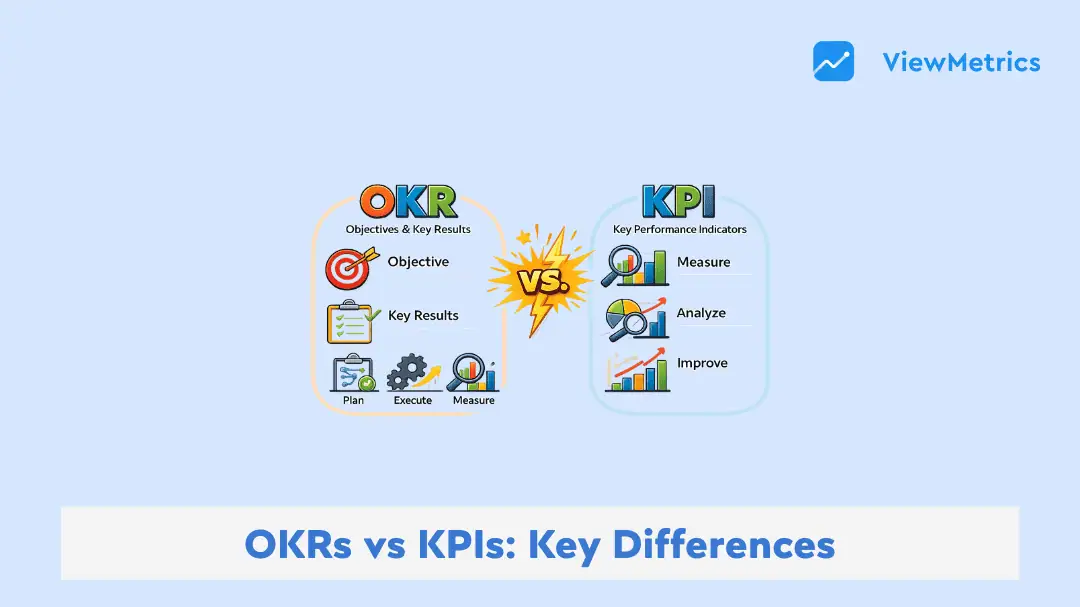
- OKRs and KPIs are frameworks that measure performance, but serve different purposes.
- KPIs track ongoing business performance, while OKRs focus on driving change and improvement.
- KPIs are continuous metrics, whereas OKRs are time-bound and goal-driven.
- You should use KPIs to monitor business or campaign health and OKRs to push strategic outcomes.
- OKRs and KPIs can work together when tracked clearly and consistently.
Performance measurement is crucial for driving business growth, yet many teams struggle to choose the right framework and tools to track progress effectively. The confusion around monitoring KPIs or OKRs often comes from the fact that both are used to measure success, but they serve very different purposes. Without a clear KPI dashboard to visualize performance and outcomes, organizations risk misaligned goals, unclear priorities, and ineffective measurement across teams.
What Are KPIs?
A KPI or Key Performance Indicator is a measurable metric used to monitor how well a process, team, or business is performing over time. They help teams monitor outcomes such as revenue growth, customer retention, or operational efficiency. Most KPIs are continuous, meaning they are tracked regularly without a fixed end date.
Across teams, KPIs share common characteristics. They are measurable, outcome-focused, and directly tied to business health. Sales teams track revenue and conversion rates, marketing teams monitor traffic and engagement, and operations teams measure uptime or defect rates.
What Are OKRs?
An OKR or Objectives and Key Results framework is a structured way to set and achieve goals. OKRs define what you want to achieve through a clear objective and how success will be measured using specific, measurable key results.
Unlike KPIs, OKRs help teams focus on specific goals they want to achieve within a set time period. They help teams stay focused by defining what needs to be achieved and how success will be measured, often over a quarter.
A typical OKR includes one objective supported by two to five measurable key results. For example, a business objective might focus on improving customer satisfaction, while key results define measurable improvements in retention or response times.
OKR vs KPI: The Core Difference Explained
The difference between OKRs and KPIs lies in their intent and usage. KPIs are standalone metrics that monitor ongoing performance and business health, such as revenue or churn. OKRs are a goal-setting framework that defines what needs to change and how progress will be measured over a specific time period. While KPIs help teams understand the current state of the business, OKRs push teams toward improvement and transformation.
| Aspect | KPI | OKR |
|---|---|---|
| What It Represents | A specific metric used to measure ongoing performance | A structured framework used to define goals and measure progress |
| Primary Focus | Maintaining and monitoring current performance levels | Driving improvement, change, or strategic progress |
| Time Frame | Ongoing and continuous with no fixed end date | Short-term and time-bound, usually set quarterly |
| Ownership | Typically managed by teams or departments | Can be owned at the company, team, or individual level |
| Use Case | Tracks operational health and efficiency | Aligns teams around clear priorities and outcomes |
| Example | Monthly revenue, customer churn rate, website traffic | Objective: Improve customer retentionKey Result: Lower churn from 6% to 4% this quarter |
OKR vs KPI: Real-World Examples Across Teams
Here are some real-life examples of how teams can use OKRs and KPIs to track and measure success:
-
Sales Team Example
A sales KPI may track monthly revenue or conversion rate to monitor ongoing performance. A sales OKR, on the other hand, might focus on expanding into a new market with clear targets for pipeline growth.
-
Marketing Team Example
Marketing KPIs often include website traffic or click-through rate to measure performance. A marketing OKR could aim to increase brand awareness in a new region, supported by measurable reach and engagement targets.
-
Operations Example
Operations KPIs track system uptime or defect rates to ensure stability. An OKR in operations may focus on improving customer experience or accelerating release velocity within a quarter.
OKR vs KPI: When to Track OKRs & When to Track KPIs
KPIs should be used when tracking ongoing business performance, monitoring stable processes, and measuring operational health. OKRs should be used when driving improvement, launching new initiatives, or aligning teams around strategic priorities.
| Goal/Situation | Use KPI | Use OKR |
|---|---|---|
| You want to monitor ongoing business performance | Yes | No |
| You need to assess overall business health consistently | Yes | No |
| You are managing stable and repeatable processes | Yes | No |
| You want to drive meaningful change or improvement | No | Yes |
| You are launching a new product, feature, or initiative | No | Yes |
| You want teams aligned around strategic priorities | No | Yes |
| You need ambitious, outcome-focused goals | No | Yes |
| You want fixed benchmarks and stable targets | Yes | No |
| You want goals that are clearly time-bound | No | Yes |
| You want to measure success rather than activity | Sometimes | Yes |
| You want clarity on what success looks like for a quarter | No | Yes |
| You want to improve focus and accountability across teams | No | Yes |
Can OKRs & KPIs Work Together Effectively?
OKRs and KPIs are not competing frameworks. In fact, they work best together. KPIs provide a stable performance baseline, while OKRs define where the business wants to go next.
Many teams use KPIs as inputs or key results within OKRs. This approach ensures that ambitious goals remain grounded in measurable outcomes.
How ViewMetrics Supports KPI & OKR Tracking
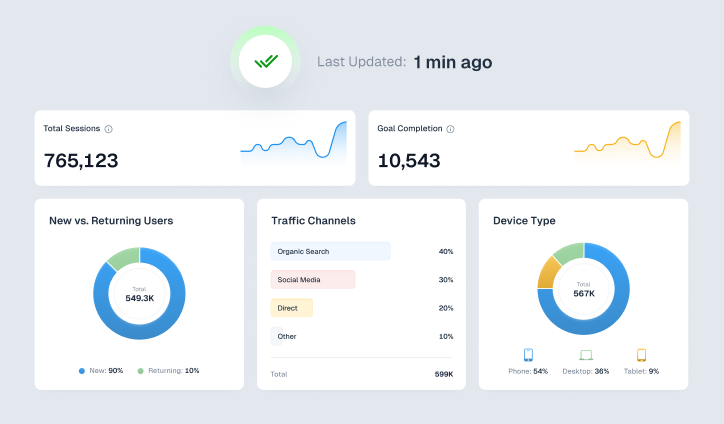
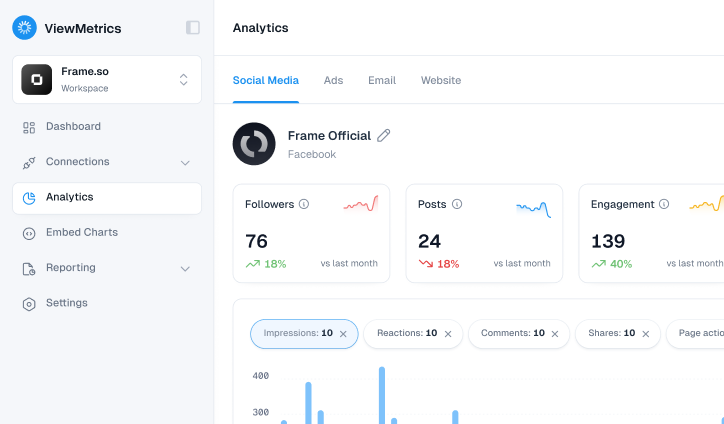
ViewMetrics helps teams track KPIs clearly and consistently across departments. By centralizing metrics into a single reporting view, teams can monitor performance without manual effort.
When KPIs are clearly tracked, teams can set stronger OKRs based on reliable data. ViewMetrics supports this by making metrics accessible, comparable, and easy to act on.


View All Your Marketing and Website Data - Instantly
 Connect Instagram, Mailchimp, Google Analytics & more
- Pre-built dashboards, no setup needed
- Save hours on reporting every week
Choosing Between OKRs & KPIs
KPI or OKR – what you choose to focus on tracking depends on what you’re trying to achieve.
KPIs help teams maintain performance, while OKRs help teams improve and grow. Understanding how and when to use each framework allows teams to stay focused, aligned, and accountable. When used together, OKRs and KPIs create a powerful system for measuring success and driving meaningful outcomes.
FAQs
-
What is the main difference between OKRs and KPIs?
The main difference between OKRs and KPIs is the purpose for which they are used. KPIs track ongoing performance, while OKRs focus on achieving specific, time-bound goals.
-
Is OKR better than KPI?
Neither of the two is better. They serve different needs. KPIs maintain performance, while OKRs drive change. And for the best results, you need to make your KPIs align with the OKRs.
-
Can a KPI be used as a Key Result in an OKR?
Yes, KPIs are often used as measurable key results within an OKR framework.
-
Should startups use OKRs or KPIs?
To make your business more successful, it’s ideal for startups to use both. Startups typically use both. KPIs track stability, while OKRs help drive growth and focus.
-
How often should OKRs be reviewed?
It’s ideal to review OKRs quarterly, with regular check-ins during the cycle.
-
How often should KPIs be tracked?
KPIs are tracked continuously, often weekly, monthly, or regularly during an active marketing campaign.
-
Are OKRs and KPIs suitable for all teams?
Yes, both frameworks can be adapted for most teams when used correctly.